 Parallel
Parking, reduced to probability.
Change is coming. Parallel studies how every Montréal street fills and empties — hour by hour, sign by sign — and gives you one honest number before you drive: the odds of finding a spot.
Every street on this is a data point recomputing itself. Parallel will always give you the probability curve — live, all day, for every block in the city.
Statistics, not sensors
Every street has a rhythm. Parallel learns it.
Patent-pending technology. No cameras, no crowd-sourcing, no wishful thinking. Parallel builds a statistical model of every block — when it fills, when it empties, and how the rules reshape the day — then hands you a single, honest number: the probability you'll find a spot to leave your car.
- A model per blockEach street segment gets its own availability curve, learned from how Montréal actually parks.
- Time-awareHour, weekday, season — the odds at 14h on a Tuesday are not the odds at 18h on a Friday.
- Rules move the mathStreet sweeping, snow bans and permit zones aren't footnotes — they're inputs to the model.
- Honest probabilitiesParallel never pretends to see the curb. It tells you the odds — and the odds are usually enough.
P(open spot) · Avenue Laurier · Tuesday — the crater is street sweeping, the evening slide is everyone coming home.
What you get at the curb
Built for how Montréal actually parks.
A probability for every block, a best time for every errand, and every confusing sign already read for you.
Odds on the map
Every block face, shaded by its probability right now.
- Street-level probability heatmap
- Tap any block for its odds and rules
- Darker means better odds
The best time to arrive
Sometimes leaving twenty minutes later doubles your odds.
- Availability curves for every street
- Spot the windows right after street cleaning
- Plan around the evening crunch
Signs, already read
The whole pole, decoded into one plain answer.
- Street-sweeping windows
- Snow-removal bans & tow zones
- Residents-only & vignette zones
A model that knows winter
Montréal parking has seasons. So does the math.
- Snow-ban aware predictions
- Festival summers & moving day
- Weekday vs weekend rhythms
Check before you leave
The odds at your destination, from your couch.
- Search any address in the city
- Odds for when you'll arrive
- Know before you go
Made in Montréal
Built by experience who parallel parks all year long.
- Borough by borough coverage
- Bilingual signs, bilingual app
- Local rules, local quirks
Real math, running under the hood.
Under the map is a probabilistic model of the whole city's curb space. It doesn't guess and it doesn't promise — it estimates, the way a good statistician would, and it gets sharper as the city teaches it more.
- Per-block granularity — every stretch of curb has its own model, not one citywide average.
- Every rule is an input — sweeping schedules, snow operations and permits reshape the odds through the day.
- Seasonal by design — a February model and a July model are different models, on purpose.
- Probabilities, not promises — you get an honest number, and honest numbers win over time.
P( spot | street, hour, season )
Software vs. hardware
Why install sensors when you can just calculate?
Cities have spent a decade bolting hardware onto curbs to solve this. Parallel solves the same problem with statistics — nothing to install, nothing to break.
| Parallel | In-ground sensors & cameras | |
|---|---|---|
| Installation | None — live the day it's turned on | Drilled or mounted per spot, city permits required |
| Cost per block | $0 hardware | Hundreds per spot, plus install crews |
| Time to citywide coverage | Immediate, borough by borough | Years, installed spot by spot |
| Maintenance | None | Batteries, cleaning, weatherproofing, repairs |
| Winter resilience | Unaffected — it's math | Snow, plows and road salt damage hardware |
| Privacy | No cameras, nothing recorded | Often camera-based, raises privacy concerns |
| What it gives you | A probability, honestly stated | A "reading" that's wrong the moment someone leaves |
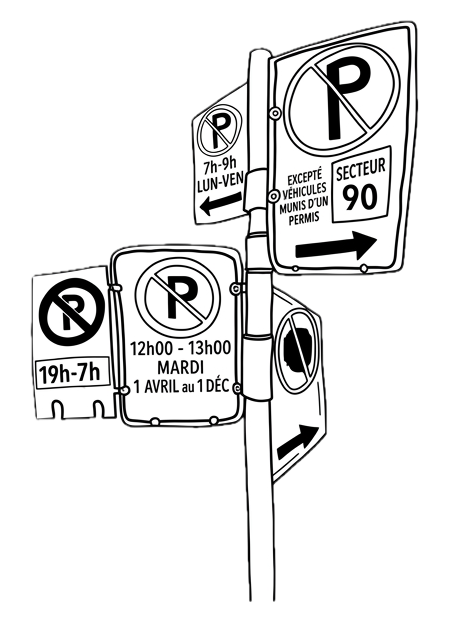
A whole pole of rules, folded into one answer — and into the odds.
Les panneaux, décodés
Signs written like riddles. Answers written in plain words.
A Montréal parking pole can stack four rules with three exceptions in two languages. Parallel reads the whole pole for you — sweeping windows, snow routes, permits, tow zones — and tells you one thing: can you park here, and until when.
- One plain answer"OK until 21h, 2h max" — not a logic puzzle at the curb in minus twenty.
- Snow ops includedWhen the orange signs go up and the tow trucks roll, Parallel knows which side of the street to be on.
- Rules feed the oddsA block that clears for sweeping at 11h is a block full of fresh spots at 11h05. The model knows that too.
For developers & partners
An API is coming.
Every probability Parallel calculates for its own app will also be available programmatically — for fleet operators, navigation apps, and city planners who want the same odds inside their own systems.
- Per-block probability lookupsQuery any street segment for any time window and get the same number the app shows.
- Decoded sign dataStructured rules — sweeping, snow bans, permits — not photos of poles.
- Built for integrationFleet management, municipal dashboards, and third-party navigation apps.
curl https://api.parallelparking.info/v1/probability \
  -G \
  -d street="avenue-laurier-o" \
  -d segment=4 \
  -d at="2026-07-08T18:00:00-04:00"

{
  "street": "Avenue Laurier O.",
  "segment": 4,
  "probability": 0.41,
  "model_version": "2026.07",
  "factors": [
    "sweeping_clear",
    "evening_rush"
  ]
}
Illustrative response — the API isn't live yet, but the model already computes this today.
Be first at the curb.
Parallel launches in Montréal this August. The math is already running — soon it'll be running for you.

Coming to the App Store — August 2026
Get in touch
Questions, feedback, or press?
Send a message and we'll get back to you.